Millennium Post · 28 January 2026
When Cinema Pauses, Gandhi Enters
How cinema has engaged with Gandhi through tone, hesitation and presence
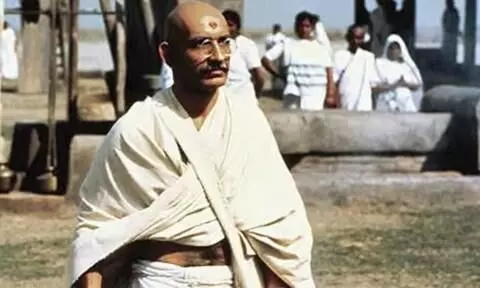
Every Indian grows up with Gandhi as a presence. He exists in photographs, in classrooms, on currency notes and in the larger public memory. Cinema, too, has never entirely let go of him. What has changed isn't Gandhi himself, but the way films choose to sit with him.
Gandhi is one of the few figures in cinema who seems to change simply by walking into a different space. His idea doesn't alter, but the room around him does.
In Richard Attenborough's 'Gandhi', the world seems to slow down in his presence. The camera lingers. Silence is allowed to stretch. His white clothes blend into the light, as if he belongs as much to the frame as to history itself.
That clarity begins to strain in 'Sardar', where Gandhian idealism meets Vallabhbhai Patel's administrative urgency. The film doesn't dismantle Gandhi's authority, but it allows tension to exist.
Then comes 'Lage Raho Munna Bhai', one of Hindi cinema's most emotionally intimate engagements with Gandhi, which does something radical in its gentleness. It turns Gandhi into a companion rather than a commander.
Regional cinema often appears more at ease with him. In 'Hey Ram', Gandhi is neither a pedestal nor comfort. The assassination isn't treated as distant history, but as a psychological rupture.
Today, Gandhi enters films not through physical presence but through tonal shift. You recognise the moment he arrives, even when he is unseen.
Gandhi doesn't ask cinema to follow him. He asks it to pause. And cinema, like society, keeps deciding how much of that pause it can afford.
All Film Analysis · Original Source